
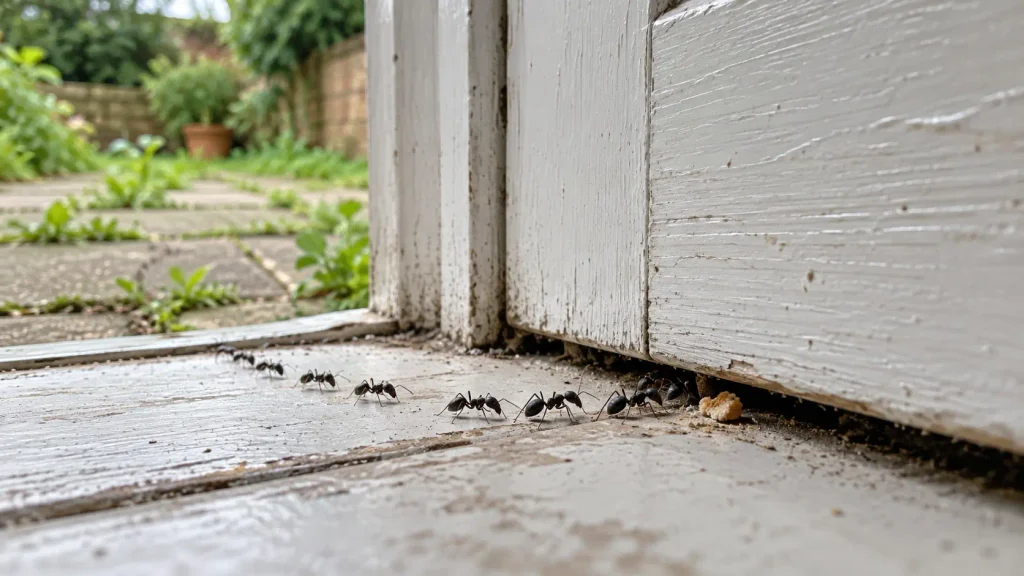
You wipe the worktop. The ants disappear.
Then the next morning, they’re back.
It’s a common problem in UK homes, especially during the warmer months. So, why are ants coming into your house?
Most of the time, they’ve found food, water or an easy way inside. In many UK homes, the ants you see indoors are black garden ants. They usually nest outside and come indoors while looking for food.
The important thing is not to panic. Seeing ants inside doesn’t always mean there’s a nest in your house. It also doesn’t mean your home is dirty.
Here’s why ants come in, what you can do about them, and when it’s worth getting professional help.
Need help with a recurring ant problem? You can find out more about our ant control service or call 07440 633057.
Why are ants coming into my house?
There are four common reasons.
1. They’ve found food
Food is one of the biggest reasons ants come indoors.
A sticky jam jar, a splash of juice, a few crumbs under the toaster or a bowl of pet food can be enough to attract them.
You might not even notice what they’re after. Ants can find very small food sources, especially sweet foods.
Once a worker finds something useful, it can leave a scent trail that helps other ants find the same route. That’s how a few ants can turn into a steady line quite quickly.
2. They’ve found water or moisture
Ants need water too.
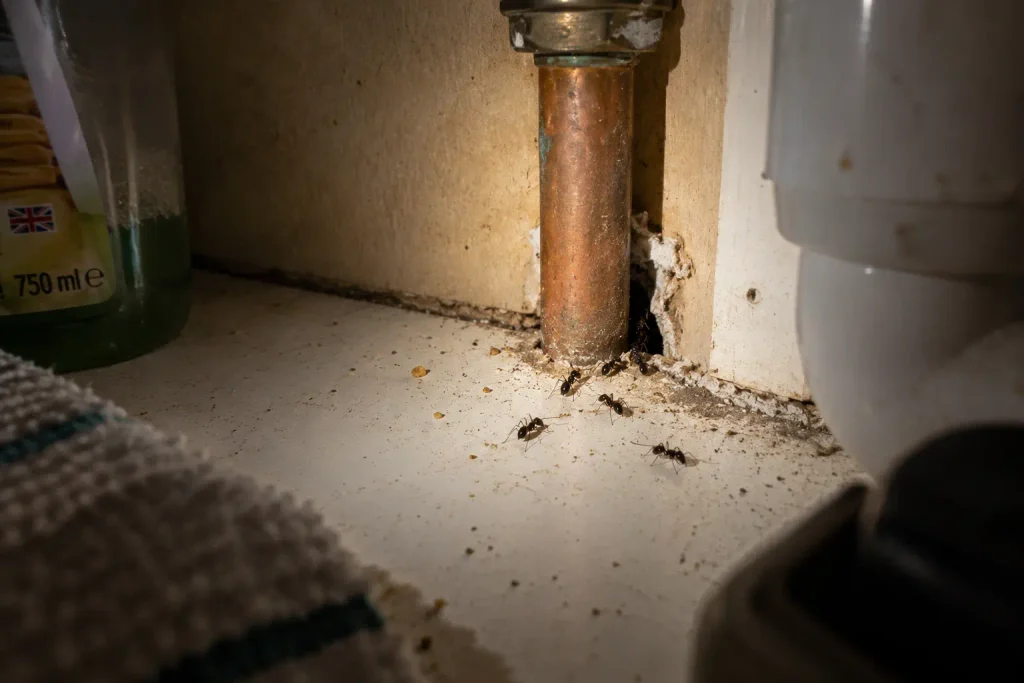
Moist areas around sinks, taps, pipes and damp cupboards can make parts of a home attractive to them.
Check for:
- Leaking taps
- Dripping pipes
- Damp cupboards
- Water around sinks
- Condensation
- Areas that stay wet for a long time
Fixing a leak won’t always solve an ant problem on its own, but it can remove one thing that’s attracting them.
3. They’ve found an easy way inside
Ants are tiny, so a gap that looks too small to matter to you can be an easy entrance for them.
Look around:
- Doors and windows
- Skirting boards
- Pipe openings
- Cable entry points
- Cracks in walls
- Floor edges
- Gaps around kitchen units
If you see ants following the same route every day, watch where they disappear. You may find the point they’re using to get inside.
4. There’s a nest nearby
The nest doesn’t have to be inside your home.
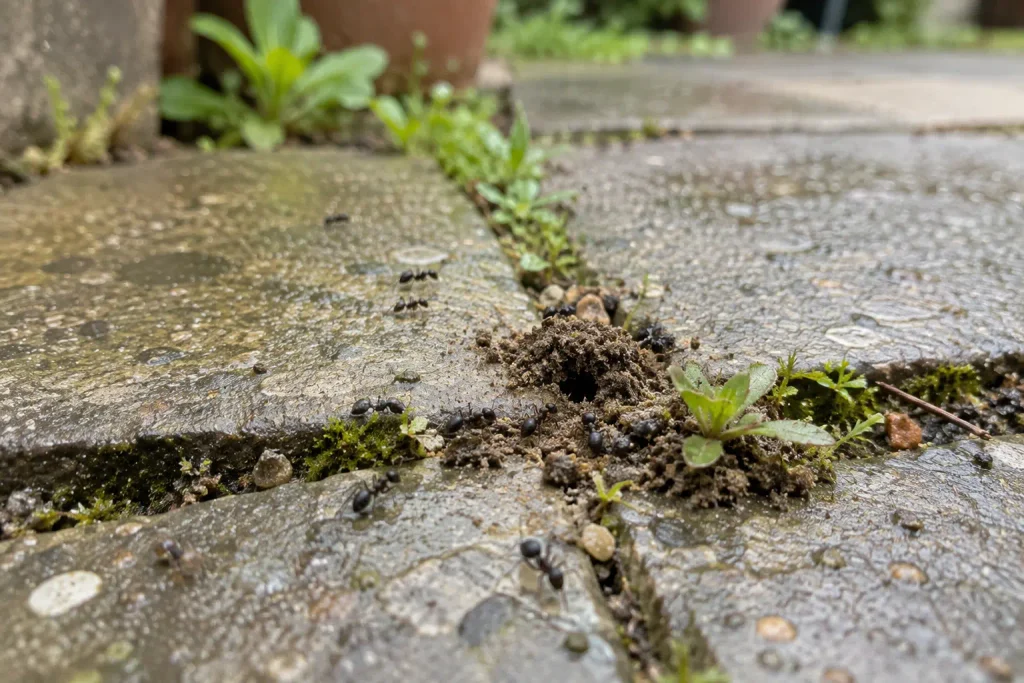
Black garden ants usually nest outdoors, including in soil, lawns, flower beds and under paving. Worker ants may then travel into nearby buildings while looking for food.
So you can have ants in the kitchen even when the colony is actually outside.
That’s also why killing the ants you can see doesn’t always solve the problem.
Why are black ants coming into my house?
If the ants are dark brown or black and fairly small, they may be black garden ants, Lasius niger.
The Black Garden Ant is the most common ant species in the UK. It normally lives outdoors but may enter buildings while foraging for food, particularly sweet food.
You may notice them:
- Around kitchen worktops
- Near food cupboards
- Along skirting boards
- Around doors and windows
- Near patios and outside walls
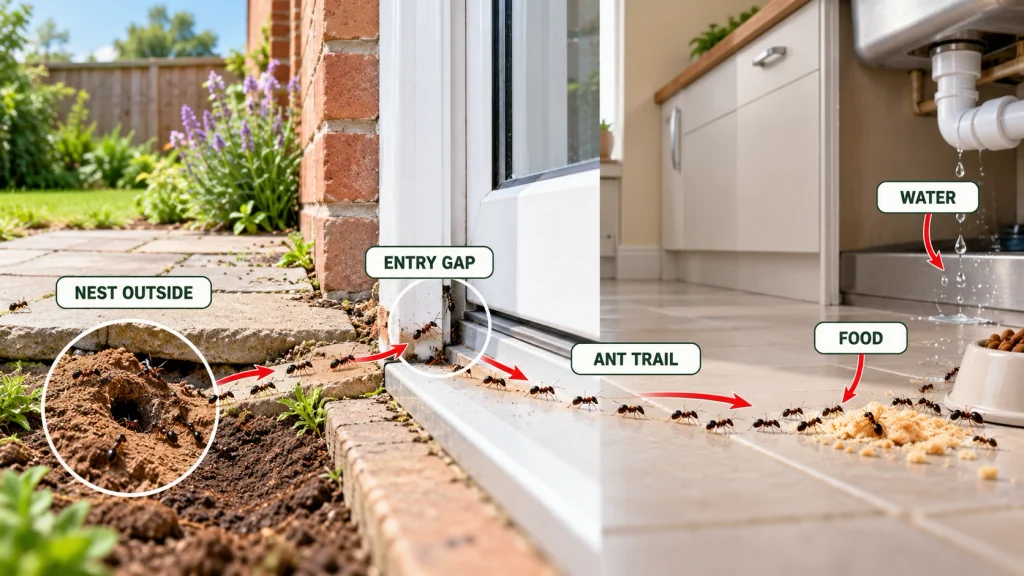
A clear line of ants is often a sign that they’re using the same route between the food and their colony.
Don’t assume the colour tells you everything, though. If the ants are unusually small, keep returning or appear in large numbers indoors, getting them identified is a good idea. Some indoor species need a different approach.
Why are so many ants coming into my house?
If you suddenly see lots of ants, they’ve probably found something worth coming back for.
One worker finding food is easy to miss. A steady trail is different.
Once ants find a useful food source, other workers can follow the same scent trail back and forth. That’s why an ant problem can seem to appear almost overnight.
If you see a long trail, don’t just wipe up the ants and leave it at that.
Take a few minutes to watch them.
Look for where the trail:
- Comes through a door or window
- Disappears behind a cupboard
- Goes through a crack
- Runs around pipework
- Leads outside
The trail can tell you a lot about what’s happening.
Why do ants come into a clean house?
Ants in your house don’t mean your house is dirty.
A clean home can still have ants because they don’t need a big food source. A little juice, a few crumbs, pet food, moisture or a small gap can be enough.
They may also simply be travelling from a nest outside.
So don’t blame yourself.
Instead, look for what is attracting them and how they’re getting inside.
Why do ants keep coming back after I clean?
This is a common one.
You clean the worktop.
The ants disappear.
Then they’re back the next day.
That’s because cleaning can remove the food, but it doesn’t necessarily remove the route they’re using or the nest.
If the same gap is still open, the ants may simply find their way back.
Try to work out where the trail starts and ends. Check around doors, windows, pipework, cupboards and outside paving.
If the ants keep returning after you’ve dealt with the obvious food and access points, there may be a less obvious source that needs a closer look.
Why are ants coming into my house after rain?
There isn’t one simple reason why you may notice ants after rain.
Changes in weather can affect ant activity and where they forage. The Natural History Museum also notes that there is anecdotal evidence that flying ants often appear after summer rain.
So if you see more ants after wet weather, don’t automatically assume that rain has flooded their nest and forced them indoors.
Instead, follow the trail.
Check the soil, paving, patio edges and outside walls close to the house. You may find a nearby nest or an easy route into the building.
Very dry weather can also bring ants closer to buildings as they search for water.
Why are ants coming into my house in winter?
Black garden ants are much less active in cold weather, so repeated ant activity indoors during winter is worth investigating.
Some tropical species can survive in heated buildings. BPCA specifically highlights Pharaoh ants and Ghost ants as species that can occur indoors, particularly in large centrally heated buildings.
So if you’re seeing lots of tiny ants during winter, don’t assume they’re ordinary black garden ants.
Getting the species identified first can help you avoid using the wrong approach.
Why are big ants coming into my house?
A large ant isn’t automatically a carpenter ant.
One reason you may see large ants in summer is flying queens and males. They are much larger than ordinary worker ants. After mating, queens can chew off their wings and begin looking for a place to start a new colony. This is why large wingless ants can sometimes be seen after a flying-ant swarm.
If you keep finding large ants indoors, take a clear photo and have them identified rather than guessing from size alone.
Why are carpenter ants coming into my house?
Carpenter ants are Camponotus ants that nest in wood.
A few Camponotus species have been recorded in the UK, but they are not the ants most commonly found in UK homes. A large ant found indoors is not automatically a carpenter ant.
If you’re finding large ants around damp or damaged timber, check the area carefully. Look around window frames, floor timbers, old leaks and other damaged wood.
Don’t try to identify the ant by size alone. A clear photograph and proper identification are much better than a guess.
Why are flying ants coming into my house?
Flying ants aren’t a different kind of ant.
They’re the winged reproductive ants from a colony: queens and males.
In UK towns and cities, the flying ants people usually notice are black garden ants. Flying-ant season normally peaks around July and August, although sightings can happen from June into early September depending on the weather and where you live.
A few flying ants around an open window don’t necessarily mean there’s a nest in your home.
Repeated winged ants indoors are more worth investigating, especially if they seem to come from a wall, floor, ceiling or another hidden space.
After mating, queens lose their wings and look like large wingless ants. So if you suddenly notice bigger ants after a swarm, that may explain what you’re seeing.
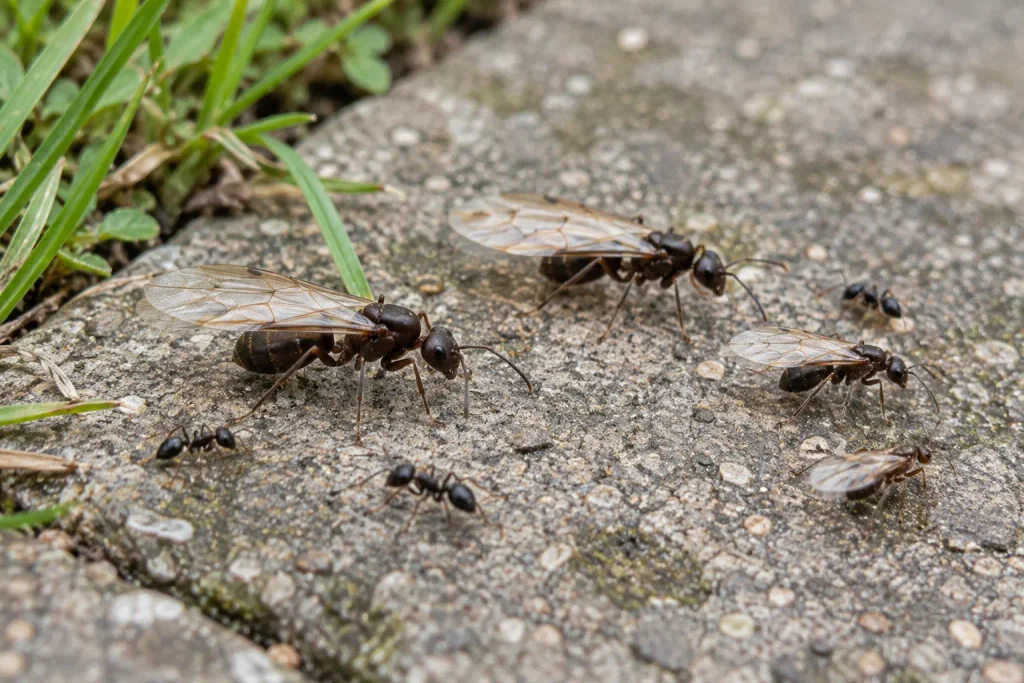
Which ant is it?
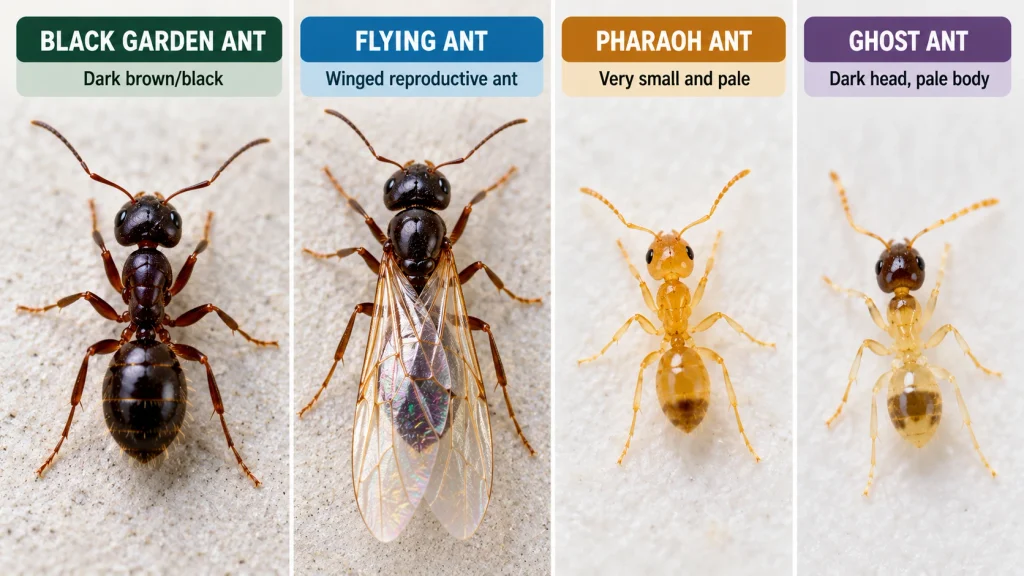
This table can help you make a first guess. It isn’t a perfect identification test, so unusual or persistent ants should still be checked properly.
| Ant | What it looks like | Where you may see it | What to do |
|---|---|---|---|
| Black garden ant | Dark brown or black | Kitchens, patios and around doors in warmer months | Remove food, follow the trail and check outside |
| Flying ant | Winged; queens are much larger than workers | Windows, lights and around buildings in summer | Check where they came from; investigate repeated indoor activity |
| Pharaoh ant | Very small, pale yellow to light brown | Warm, heated buildings | Don’t spray; get the species identified |
| Ghost ant | Tiny, with a dark head and pale or translucent body | Warm buildings, often around food or moisture | Don’t spray; get the species identified |
BPCA says correct identification is especially important for indoor species such as Pharaoh ants and Ghost ants because they can need different management. Some can also spread when disturbed by unsuitable treatments.
Pharaoh ants can also be attracted to protein rather than mainly sweet foods, which is another reason not to assume that every tiny ant is the same species.
What should I do if I find ants in my house?
Start with the simple things.
1. Remove the food source
Clean up crumbs and spills.
Pay extra attention to:
- Sugary drinks
- Jam and honey
- Pet food
- Food waste
- Sticky containers
- Food under kitchen appliances
Keep food in sealed containers where possible.
2. Check for water
Look around sinks, taps, pipes and cupboards for leaks or damp areas.
3. Follow the trail
Don’t rush to kill every ant.
Watch the trail for a few minutes and see where the ants are coming from and where they’re going.
4. Check outside
Look around:
- Paving
- Soil
- Garden borders
- Patio edges
- External walls
- Areas close to doors
A nearby outdoor nest may explain why the ants keep entering.
5. Deal with obvious gaps
Once you’ve worked out the route, repair or seal suitable gaps around doors, windows, pipework and other openings.
Preventing pests from getting inside is an important part of pest control.
Do vinegar, lemon or essential oils get rid of ants?
You’ll find plenty of advice online about vinegar, lemon, peppermint oil, cinnamon and other home remedies.
They may disturb an ant trail for a short time, but that doesn’t mean they’ve dealt with the nest.
For a lasting solution, it’s more useful to find the food source, entry route and likely source of the ants.
Can I get rid of ants myself?
Sometimes, yes.
A few black garden ants entering from outside may improve once you remove the food source and deal with an obvious entry point.
It’s a different story when:
- Ants keep coming back
- There are large numbers every day
- You can’t find the source
- Ants are appearing in several rooms
- The ants are tiny or unusual-looking
- Flying ants keep appearing indoors
- Ants seem to be coming from walls, floors or other hidden areas
- DIY treatment hasn’t solved the problem
In those situations, it’s better to understand the problem before trying lots of different products.
Should I use ant spray or ant bait?
It depends on the type of ant and the situation.
Spraying the ants you can see may give quick results, but it doesn’t necessarily deal with the source.
For common black garden ants, suitable consumer ant-control products may be an option when the label allows them. BPCA advises that products for general-public use should be used strictly according to the label.
Bait works differently. Worker ants can carry suitable bait back towards the colony, so killing them around an active bait can interfere with that treatment approach.
Pharaoh ants are different again. BPCA warns that unsuitable sprays and dusts can cause these colonies to scatter and split, which can make the problem harder to control.
So don’t assume that the same product is right for every ant.
For any biocidal product, check that it is intended for general-public use and follow the label. HSE distinguishes between products for non-professional users and those intended for professional users.
When should I call a pest controller?
You don’t necessarily need a pest controller because you’ve seen one or two ants.
Professional help makes more sense when the problem keeps returning or you can’t work out where the ants are coming from.
Consider getting help when:
- Ants keep coming back after cleaning
- You can’t find the entry point
- You’re seeing large numbers every day
- Ants are appearing in several rooms
- The ants are very small or unusual-looking
- Flying ants keep appearing indoors
- Ants seem to come from a wall, floor or other hidden space
- DIY treatment hasn’t solved the problem
If you’re unsure what type of ant you’re dealing with, identification is especially useful before treatment.
How professional ant control works
Good ant control is about more than killing the ants you can see.
A technician should first look at what’s actually happening.
This may include checking:
- The ant species
- Ant trails
- Entry points
- Food and moisture sources
- Indoor activity
- Outdoor areas around the property
- Places where ants may be nesting or travelling unseen
The treatment should then be chosen according to the species, location and circumstances rather than using the same method for every ant problem.
Correct Pest Solution provides professional ant control for homes and businesses across London, with an inspection-led approach designed to identify the likely cause and choose treatment according to the problem found.
Learn more about professional ant control in London →
How can I stop ants coming back?
Once you’ve dealt with the immediate problem, prevention is much easier.
Keep food sealed and clean up spills quickly.
Don’t leave pet food exposed for long periods.
Fix leaking taps and pipes where possible.
Check around doors, windows, skirting boards and pipe entries for gaps.
Keep an eye on patios, paving, garden edges and outside walls.
And if ants start using the same route again, don’t just keep killing the visible ants. The repeated trail is a clue that something is still attracting them or giving them access.
Are ants in the house a sign of poor hygiene?
No.
Finding ants indoors doesn’t automatically mean a home is dirty.
Black garden ants often enter buildings from outside while looking for food, so even a clean home can have ants if there’s a small food source or an easy way inside.
Cleaning helps, but it’s only part of the answer.
You also need to look at how the ants are getting into the property.
Frequently asked questions
Why are ants suddenly coming into my house?
Usually because they’ve found food, moisture or an easy route into the building. A nearby outdoor nest can also lead to a sudden increase in activity.
Why are black ants coming into my house?
Black garden ants commonly enter UK homes while looking for food. They usually nest outside and may follow the same route into a building.
Why are there so many ants in my house?
A large trail can mean the ants have found a reliable food source and are repeatedly using the same route.
Why do ants keep coming back after I clean?
Cleaning can remove food and scent trails, but the entry route or nearby colony may still be there.
Why are ants coming into my house after rain?
Changes in weather and moisture can affect ant activity. Summer rain can also be followed by flying-ant activity, although the Natural History Museum describes the evidence for that link as anecdotal.
Why are ants coming into my house in winter?
Black garden ants are less active in cold weather, so repeated winter activity indoors is worth investigating. Some indoor species can survive in heated buildings.
Are flying ants a sign of an infestation?
Not necessarily. Flying ants are reproductive queens and males and are commonly seen during the UK summer. Repeated flying-ant activity indoors should be investigated.
Can I get rid of ants without a pest controller?
Sometimes. Small numbers of common black garden ants may improve after removing food sources and dealing with suitable access points. Persistent or unusual activity may need professional identification and treatment.
When should I call a professional?
Consider calling a pest controller when ants keep returning, you can’t find the source, several rooms are affected, or you aren’t sure what type of ant you’re dealing with.
The bottom line
If ants are coming into your house, don’t panic.
In many cases, they’re simply coming in from outside because they’ve found food, water or an easy route indoors.
Start with three simple questions:
What are they looking for?
Where are they getting in?
Where are they coming from?
Remove food, check for moisture, follow the trail and look around the outside of the property.
If the ants keep returning, appear in several rooms, look unusual or seem to be coming from hidden parts of the building, it’s worth getting the problem properly assessed.
For homes and businesses across London, Correct Pest Solution provides professional ant control.